
Wagyu, explained
Japanese Wagyu
Wagyu means “Japanese cattle,” and in Japan it is a legal classification rather than a flavour note. Four recognized breeds, a grading system that uses the lowest of four quality-factor scores, and a traceability number that follows an animal from birth. Here is how it actually works.
What counts as Wagyu in Japan
Japan’s Ministry of Agriculture, Forestry and Fisheries defines Wagyu narrowly: four breeds developed in Japan, and crosses between those four. That second clause matters, because it means Wagyu is a closed set. A Wagyu-Angus cross, however good, is not Wagyu under the Japanese definition.
- Japanese Black
More than 90 percent of the Wagyu raised in Japan. Many widely exported brands, including Kobe and Miyazaki, require Japanese Black.
- Japanese Brown
Also called Akaushi, or red cattle. Leaner than Japanese Black, and associated with Kumamoto and Kochi.
- Japanese Shorthorn
Raised mainly in northern Japan and a small share of Wagyu production; generally leaner and less marbled than Japanese Black.
- Japanese Polled
Naturally hornless, associated with Yamaguchi, and a small part of national production.
You will sometimes see “98 percent Japanese Black” quoted. The ministry’s own figure is more than 90 percent, and that is the number worth trusting. The four breeds in detail.
How the grading actually works
A Japanese carcass gets two independent scores, and the famous label is simply the two stuck together.
- Yield grade: A, B, or C
How much saleable meat comes off the carcass. A is above standard, B standard, C below. It says nothing about marbling.
- Quality grade: 1 to 5
Judged on four things: marbling (BMS 1 to 12), meat colour and brightness (BCS 1 to 7), firmness and texture, and fat colour and quality (BFS 1 to 7).
So A5 is yield grade A plus quality grade 5. The detail almost everyone skips is how the quality grade is reached: it is the lowest of those four scores, not an average. A carcass with spectacular BMS 12 marbling but a meat colour score of 4 is graded 4, not 5. Marbling gets the attention, but it cannot carry the other three.
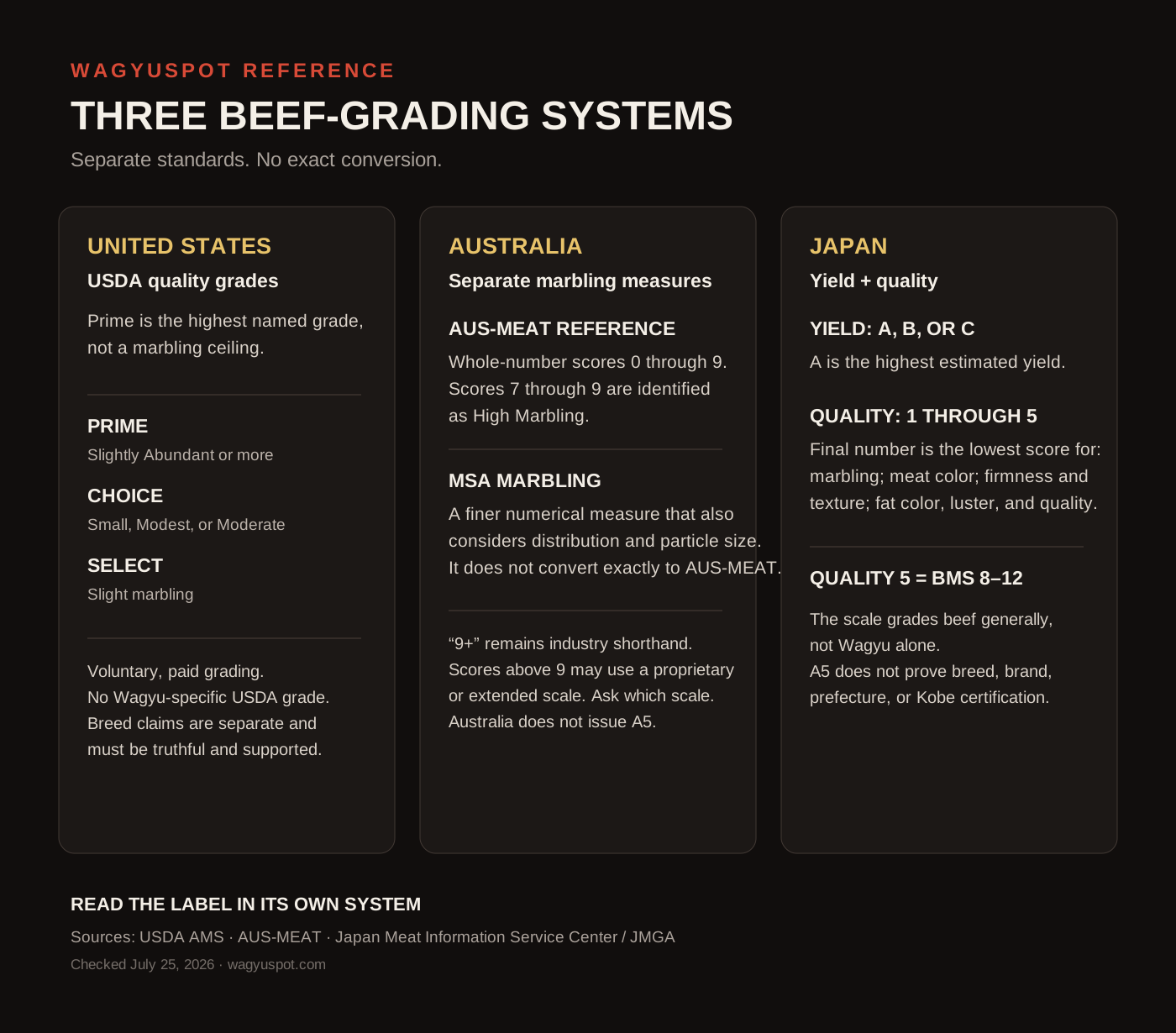
Within grade 5 there is still a wide range. BMS 8 is the floor and BMS 12 is the ceiling, and both are sold as A5. A5, in depth.
Brands, prefectures, and why they are not grades
Kobe, Matsusaka, Omi, Miyazaki: these are brands, usually defined by a prefecture or a producer council, each with its own rules about where the animal was raised and what it must grade. A grade is a score; a regional brand adds a separate production standard. Naming both adds useful detail but does not replace traceability.
Some brands set their own grade floor. Saga Beef, for example, requires quality grade 4 or 5 and BMS 7 or above, so beef from Saga that misses it is sold under a different, plainer label. Browse prefectures and brands, or see the verified Kobe list.
The 10-digit number
Under Japan’s beef traceability law every animal is assigned a unique 10-digit individual identification number, carried on an ear tag and following the carcass through processing. Anyone can enter it in the national database.
What it returns is worth knowing precisely, because sellers sometimes imply more: date of birth, sex, breed, the mother’s ID number, and the sequence of places the animal was raised with the dates it moved. It does not return the grade, and it says nothing about the particular cut in front of you. A 10-digit number proves identity and origin. It is not a quality certificate.
Why Japan's genetics stopped leaving
The story you will read almost everywhere is that Japan banned Wagyu exports in 1997 and declared the breed a national treasure. Neither is quite true, and the real version is more interesting.
1997 is the year of the last live exports, not the date of one blanket export-ban law. Animal-health requirements and the absence of workable import protocols can stop live cattle, semen, or embryos at quarantine. Private contracts and domestic-use restrictions can also limit transfer, so it is too simple to call the barrier purely quarantine.
After a 2018 attempted transfer of fertilized eggs and semen toward China, Japan enacted two livestock genetic-resource laws in 2020. They created protections and penalties around unauthorized use and transfer, including attempted exports that violate contractual domestic-use restrictions. These protections now operate alongside quarantine and animal-health rules.
The practical consequence for a diner: Wagyu ancestry outside Japan traces to a small founder population exported before 1997. American and Australian Wagyu may be fullblood or crossbred, so the whole animal does not necessarily descend only from Wagyu founders.
From draft animals to modern beef culture
Wagyu cattle were draft animals for most of their history, bred for strength in rice paddies rather than primarily for meat. An imperial edict in 675 CE restricted eating cattle, horses, dogs, monkeys, and chickens, and later governments issued additional restrictions. Religious and social taboos made beef uncommon for long periods, but meat eating persisted in limited contexts, so this was not one uninterrupted, twelve-century total ban.
In the early Meiji era, the Emperor’s public consumption of beef in January 1872 became a powerful symbol of changing official attitudes and modernization. It did not single-handedly create Japanese beef culture, but it helped normalize a broader transition already under way. Modern beef breeding and selection developed during and after that transition; today’s extreme marbling is not an unchanged ancient tradition.
Common questions
- What is Japanese Wagyu?
- Wagyu is a Japanese classification of cattle, not a description of how beef tastes. Japan's agriculture ministry identifies four recognized breeds and permitted crosses among them: Japanese Black, Japanese Brown, Japanese Shorthorn, and Japanese Polled. More than 90 percent of the Wagyu raised in Japan is Japanese Black.
- How is Japanese Wagyu graded?
- Two separate judgements. The yield grade is A, B, or C, measuring how much saleable meat comes off the carcass. The quality grade is 1 to 5, judging marbling, meat colour, firmness and texture, and fat quality. A5 means top yield and top quality. The quality grade is the lowest of those four scores, not an average.
- What is BMS in Japanese beef?
- BMS is the Beef Marbling Standard, a 1 to 12 scale for how much fat is threaded through the muscle. It feeds the quality grade: BMS 8 or above is grade 5, BMS 5 to 7 is grade 4. There is no BMS 0, and two A5 steaks can differ a lot, because BMS 8 and BMS 12 are both grade 5.
- Why can't you buy Japanese Wagyu cattle?
- There was no simple 1997 statute declaring Wagyu a national treasure and banning every export. The last live exports occurred in 1997. Animal-health protocols, quarantine, private transfer restrictions, and, since 2020, laws protecting livestock genetic resources all now affect whether genetics can leave Japan.
- Can you trace Japanese Wagyu to the individual animal?
- Yes. Under Japan's beef traceability system every animal carries a unique 10-digit number, and a public lookup returns its date of birth, sex, breed, its mother's ID, and the sequence of places it was raised. It does not return the grade or anything about the specific cut, so a 10-digit number proves identity and origin, not quality.