
Wagyu, explained
What is A5 Wagyu?
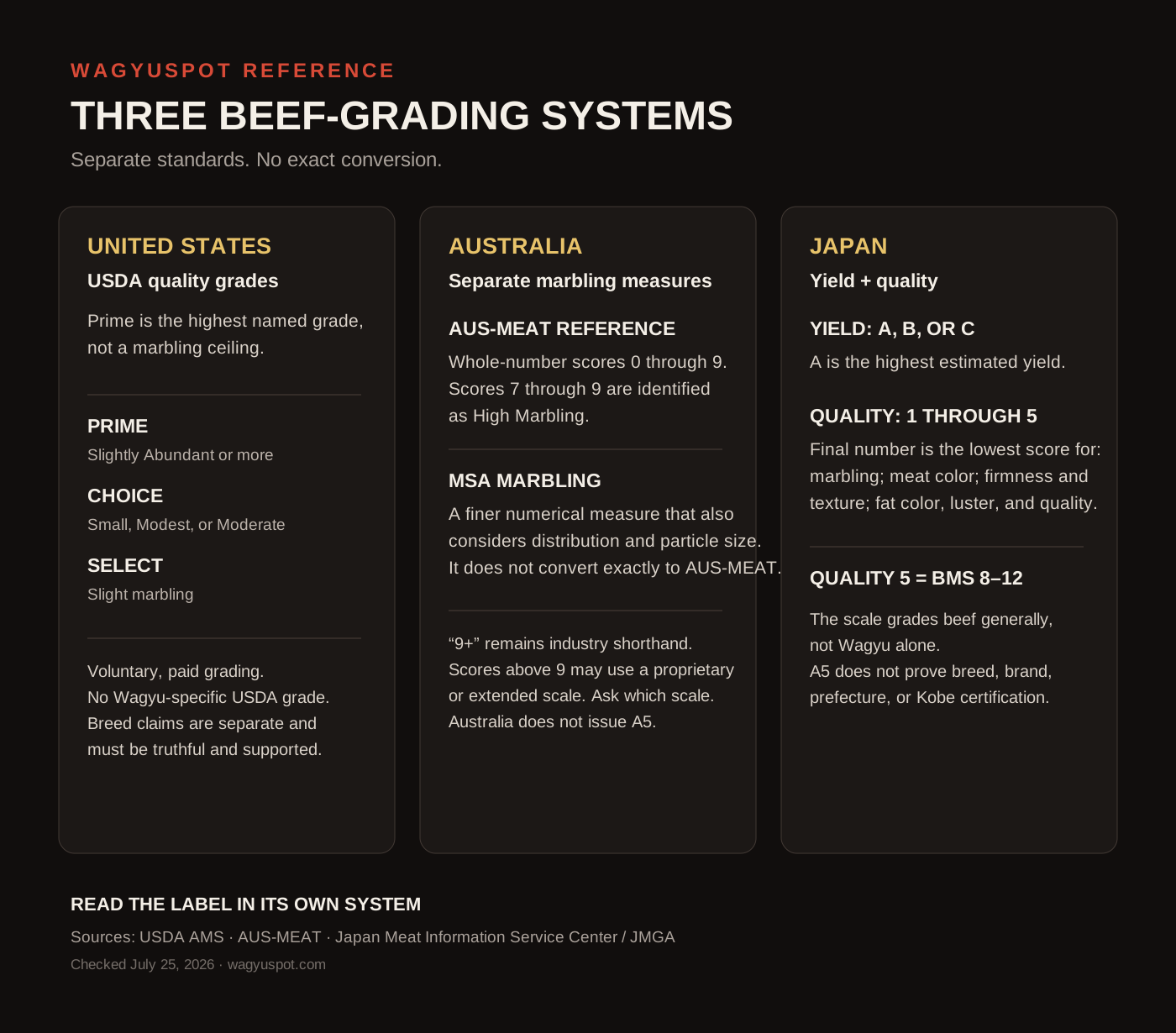
A5 is the top combination on Japan’s beef carcass-grading scale. The scale applies to beef generally, not Wagyu alone, and A5 is a grade rather than a brand, breed, or place. Understanding the letter and number is the fastest way to read a Japanese beef menu.
A grade, not a brand
A5 does not name a farm, a region, or a cut. It is the verdict of Japan’s grading body on a single carcass. Kobe, Miyazaki, and Omi are brands; A5 is the report card a qualifying carcass receives. A5 alone does not prove Wagyu ancestry or a Japanese brand. That is why you can have A5 from many prefectures, and why Kobe is a narrower claim than A5.
How the two parts work
Japan grades beef on two axes, and A5 is the top of both:
- The letter: yield grade
A, B, or C, measuring how much usable meat the carcass yields. A is the highest.
- The number: quality grade
1 to 5, judging marbling, color, firmness, and fat quality together. 5 is the highest.
So A5 is top yield and top quality. Inside the quality score sits the BMS (Beef Marbling Standard), a 1 to 12 marbling number: quality grade 5 requires BMS 8 through 12. The final quality grade is still capped by the lowest of all four quality factors.
A5 vs A4, and the BMS inside
A5 is not automatically the “right” choice. A4 means at least one quality factor scored 4, but that limiting factor is not necessarily marbling. An A4 steak can therefore be highly marbled, while two A5 steaks at BMS 8 and BMS 12 can also look very different. A good menu names the grade and, ideally, the prefecture or brand and BMS.
A5 is one of fifteen grades, and the rest of the scale is more interesting than it sounds: A1 through A5 and the B and C rows explained, including why A1 is the bottom rather than the top.
The four scales side by side
Four different systems get quoted at American buyers, and sellers routinely present a number from one as though it meant something on another. Here is what each scale actually is, who assigns it, and what the top of it means.
| Scale | Range | Who assigns it | What the top means |
|---|---|---|---|
| Japanese BMS | 1 to 12 | Japan Meat Grading Association, in Japan | BMS 8 and above sits inside quality grade 5 |
| Japanese yield + quality | A to C, then 1 to 5 | Same, on Japanese carcasses only | A5 is top yield and top quality, capped by the lowest factor |
| AUS-MEAT marble score | 0 to 9, often written 9+ | Australian graders, on Australian carcasses | 9+ is an open-ended top band, not a fixed ceiling |
| Producer marble score (e.g. MBS) | Set by the producer, e.g. bands of 2-3 to 9+ | The producer, against its own reference | Means what that producer defines, and nothing outside it |
| USDA | Select, Choice, Prime | USDA graders | Prime has no marbling maximum, so it cannot express Wagyu range |
None of these rows converts into another.There is no published, authoritative conversion table between BMS, AUS-MEAT, a producer scale, and USDA, because each is scored against its own reference photographs on its own carcass population. A seller who writes “marble score 9, equivalent to A5” has not translated between systems. They have asserted an equivalence nobody issues.
The practical rule is short: compare within a scale, never across one. A number is only informative next to other numbers from the same system, which is also why the most useful listings name the scale rather than just the number.
A5 belongs to Japan's grading system
This is the single most useful thing to remember. A5 is issued under Japan’s grading system, so the official grade applies to carcasses graded there. American Wagyu is described by breed status, producer, and any USDA grade or program; Australian Wagyu by its producer, breed content, and named Australian marbling scale. When “A5” appears next to American or Australian beef, it can only be an informal comparison and should not be represented as the official grade of that carcass.
Where to find official A5 claims
Official A5 means the carcass was graded under Japan’s system in Japan. A5 alone does not establish Wagyu ancestry, a regional brand, or a prefecture; those require separate provenance evidence. On our directory, a listing only counts as verified Japanese Wagyu when current first-party evidence names the brand or prefecture and the grade.
Wagyu restaurant directory · Browse by prefecture · What A5 costs
Common questions
- What does A5 mean in Wagyu?
- A5 is the top combination on Japan's beef carcass-grading scale. The letter is yield grade (A is highest of A, B, C) and the number is quality grade (5 is highest of 1 to 5). The system grades beef generally, not Wagyu alone, so A5 does not by itself establish breed, brand, or prefecture.
- What is the difference between A5 and A4 Wagyu?
- A5 has quality grade 5 and A4 has quality grade 4, but the difference is not always marbling. Japan sets the quality number to the lowest result among marbling, meat color and brightness, firmness and texture, and fat color, luster, and quality. Within A5, BMS runs from 8 through 12.
- Is A5 the same as Kobe?
- No. A5 is a carcass grade; Kobe is a specific brand of Tajima cattle from Hyogo Prefecture with additional production rules. Kobe can qualify at yield grade A or B and quality grade 4 or 5, so B4, B5, A4, and A5 are all possible Kobe grades. Most A5 beef is not Kobe.
- Can American or Australian Wagyu be A5?
- Not as an official grade. A5 is issued to carcasses graded under Japan's system in Japan. American Wagyu uses breed documentation and may carry a USDA grade; Australian beef uses Australian grading and marbling systems. A seller may use A5 informally as a comparison, but it is not an official grade for US- or Australian-graded beef.
- Is A5 Wagyu worth it?
- That is a preference and budget decision. A small, traceable tasting can help you decide before buying a large portion. Compare the cut, BMS when disclosed, origin evidence, serving format, and delivered price rather than assuming the grade guarantees personal value.