
Buyer’s guide
How to spot authentic Wagyu
The word “Wagyu” appears on products ranging from imported Japanese steaks to crossbred burgers. Those formats can all contain Wagyu; the claim becomes useful only when the available evidence identifies what it means. Here is how to match ancestry, origin, grade, producer, and brand claims to the documentation that can support them.
Why the word needs context
Wagyu claims appear under different labeling and menu rules around the world. The word alone does not disclose ancestry, origin, grade, or brand, and a menu may offer a “Wagyu slider” without those details. The practical response is to ask what evidence supports the particular claim rather than treating the word as proof or as fraud.
What real provenance looks like
Authenticity is origin-specific. Each of the three main origins proves itself a different way. Useful disclosure matches the evidence to the claim:
- Japanese
A named prefecture or brand (Miyazaki, Kagoshima, Omi, Kobe) plus a JMGA grade (A5, A4) and often a BMS number. Certified Japanese Wagyu traces to a 10-digit ID.
- American
A stated breed status (fullblood, purebred, or F1 crossbred) and a named producer or ranch. Many U.S. programs use a Wagyu-Angus cross, while fullblood and purebred programs also exist.
- Australian
A named producer, breed content where disclosed, and the specific Australian marbling scale and score. Australian Wagyu covers a broad range, so no country-wide marbling level should be assumed.
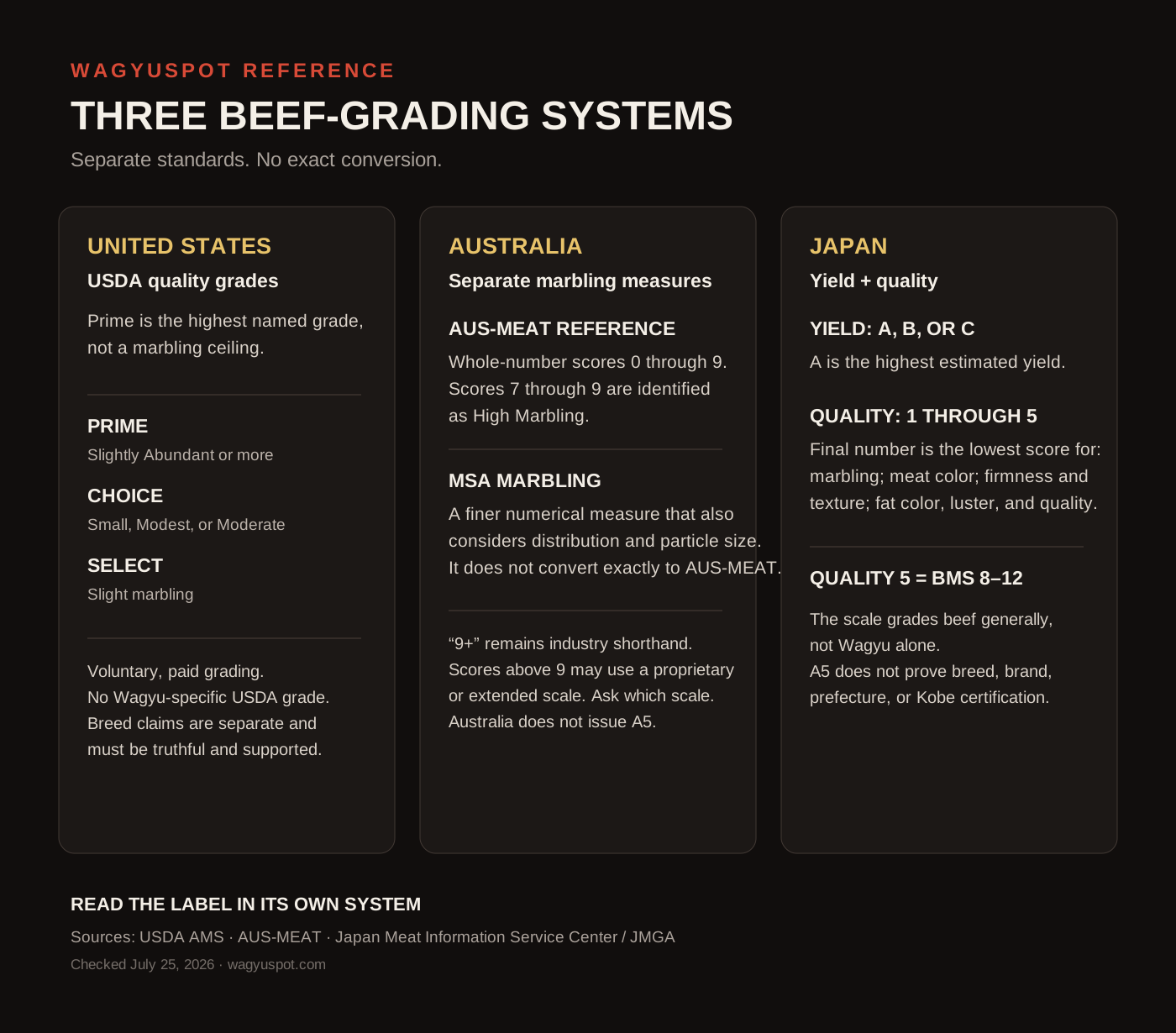
No single detail proves every part of a claim. Match the evidence to what is being advertised: grade for carcass quality, records for ancestry and origin, and the relevant registry or certificate for a protected regional brand.
The American label that did not exist before 2025
For as long as the word has been sold here, the honest answer to “is it actually Wagyu” has been that nobody official was checking. In January 2025 that changed. USDA’s Agricultural Marketing Service published a specification, the Authentic Wagyu Beef Program, and the American Wagyu Association launched two schemes under it. The first package carrying a Certified Authentic Wagyu label shipped in September 2025.
This is not the first time USDA has certified a Wagyu program. It has approved producer-specific schedules for years, including one filed in 2014 for Rosewood Ranches. What is new is a breed-wide program any qualifying producer can enter.
What a carcass has to clear
- Genotype
The animal meets the process-verified genotype requirements or the association’s live-animal specification. Both routes require the beef to be born, raised and harvested in the United States.
- Grade
U.S. Prime, with a minimum marbling score of moderately abundant or higher. Steer and heifer carcasses only, practically free of capillary rupture in the ribeye and free of dark-cutting characteristics.
- Who decides
Carcasses are presented to a USDA grader for certification on the rail. A producer cannot buy the labels; the packing plant applies them under licence.
The grade requirement is the part most often reported wrongly, including in an earlier version of this site’s own writing. The label is not a breed check alone. It is a breed check and a marbling floor, and a carcass that grades below high Prime does not qualify however impeccable its pedigree.
Three genotype tiers, and the arithmetic under the third
- Fullblood, 100 percent
Registered with the association and DNA parent-verified to both sire and dam, with both parents registered too.
- Purebred, 93.75 percent minimum
The same registration and DNA parent verification on both sides.
- Wagyu influence, or American Wagyu
Traceable to at least one registered parent that is fullblood or purebred. No DNA verification of the animal itself is required.
Do the arithmetic on that third tier, because it is the floor beneath the phrase American Wagyu even inside a certified program. One parent at 93.75 percent or better makes the animal itself a little under half Wagyu, and that qualifies. The specification also sets a deadline the industry has not much discussed: from 1 January 2030, that parentage has to be evidenced by an association registration certificate rather than by an affidavit.
The part a shopper most needs
The generic Certified Authentic Wagyu label does not say fullblood, purebred or F1. It carries room for a company name and nothing about breed percentage. Only the process-verified route, which tags calves with an RFID ear tag at birth and carries DNA traceability through to the package, produces a label that can state the percentage. So the label on its own tells you the animal had registered Wagyu parentage, was born, raised and harvested here, and graded at least high Prime. It does not tell you how much Wagyu is in it. That question is still worth asking.
And three things it is not. It is not a Japanese grade: A5 is the top band of a scale that keeps measuring above it with a BMS number, while this is a single pass mark that a carcass either clears or does not. It is not a register of authorised sellers, which is how Kobe is controlled. And it is not retrospective, so American Wagyu bought before 2025 carries none of it and its absence proves nothing about beef sold then.
How to check whether a producer actually has it
There is no public register, and that is the sharpest difference from Kobe, whose authorised handlers are named on a list anyone can read. The association publishes no directory of licensed producers. What exists instead is the label itself: carcasses are certified on the rail by a USDA grader and the packing plant applies the label under licence, so a producer cannot print one for itself. If a seller claims the certification and the label appears nowhere on the product, the question to ask is which plant certified it.
One caution for anyone researching this themselves. The association hosts a map that looks like a producer list and is not one. It is titled Member Interest, it is built from a sign-up sheet, and an entry means a producer asked to hear more rather than that anything has been certified. Read in August 2026 it carried about a hundred names. Several of them are producers listed in this directory, and only one of those publishes the label. A map is not a register.
Primary sources: USDA AMS G-162, Authentic Wagyu Beef Program · AWA live animal specification filed with AMS
Claims that need follow-up
These do not mean the beef is bad or fake, but the available disclosure is incomplete:
“Wagyu” with no ancestry or origin. A burger or slider can contain Wagyu, but the format and the word alone do not establish breed content.
“A5” on U.S.- or Australian-graded beef. Those grading systems do not issue the official Japanese A5 grade; ask whether the term is only a comparison.
“Kobe” without an authorized chain. U.S.-raised beef is not official Kobe. For restaurant verification, check the official registry and the current menu together.
No producer, no prefecture, no score. Premium pricing with none of the provenance details needed to evaluate the claim.
Three questions that clarify the claim
You do not need to be an expert. Ask a server or read the menu for these:
- Where is it from?
A prefecture or brand (Japanese), a ranch and breed status (American), or a producer (Australian). The answer identifies which evidence should exist.
- What grade or score?
A5 or A4 with a BMS for Japanese, a marble score for Australian, a breed status for American. “Just Wagyu” is not a grade.
- Who raised it?
A named producer gives you something to check. If no one can say, treat the provenance as unverified and decide accordingly.
Or let the verification be done for you
This is the reason WagyuSpot separates evidence levels. Documented Japanese origin and grade, American breed status and producer, or Australian producer and named score can support verification. Kobe requires both the official venue directory and a current menu. A current first-party Wagyu claim without full provenance appears as a menu claim only, without an authenticity badge.
How we verify · Wagyu marketing case studies · What is Kobe beef · Wagyu by prefecture & brand
Common questions
- How do I know if Wagyu is real?
- Ask for evidence appropriate to the claim: Japanese beef by animal ID, origin or brand, and grade; American Wagyu by breed status and producer; Australian Wagyu by producer, breed content when disclosed, and the named marbling scale and score. A menu that says only Wagyu may describe Wagyu beef, but it does not let a customer verify ancestry or provenance.
- What is fake Wagyu?
- The useful distinction is between a substantiated claim, an incomplete claim, and a false or misleading one. A burger can contain Wagyu, so format proves nothing. Official A5 belongs to Japan's grading system, and official Kobe requires the Kobe association's criteria and authorized chain. Missing provenance makes a claim unverified to the customer; it does not by itself prove fraud.
- Is American Wagyu real Wagyu?
- American Wagyu may be fullblood, purebred, or crossbred, commonly with Angus. Breed status and a named producer make the claim more informative. It is a different production and grading context from Japanese A5, and quality or value depends on the specific product rather than the country name alone.
- Does A5 mean it is authentic?
- A5 is official for carcasses graded under Japan's system in Japan. American and Australian systems do not issue that official grade. A5 describes yield and quality; by itself it does not prove Wagyu ancestry, a prefecture, or a regional brand, so check separate provenance evidence.
- Can a US restaurant serve real Kobe?
- Yes, through the Kobe association's authorized chain. WagyuSpot gives a restaurant a Kobe badge only when the venue appears in the official directory and Kobe is on its current menu. A seller may also source through an authorized distributor, so ask for the certificate and chain tied to the exact product.
- Is there a USDA certification for American Wagyu?
- Since January 2025, yes. USDA's Agricultural Marketing Service publishes the Authentic Wagyu Beef Program specification, and the American Wagyu Association runs a certification program and a Process Verified Program under it. A qualifying carcass must be traceable to registered Wagyu parentage, be born, raised and harvested in the United States, and grade U.S. Prime with a minimum marbling score of moderately abundant, judged by a USDA grader. The first labeled package shipped in September 2025.
- Does the Certified Authentic Wagyu label say whether beef is fullblood?
- Not by itself. The generic certification label carries a company name and no breed percentage, so it does not distinguish fullblood from purebred from a cross. Only the Process Verified route, which tags calves with RFID at birth and carries DNA traceability to the package, produces a label that can state the percentage. Ask for the breed status separately.
- How much Wagyu does certified American Wagyu have to contain?
- Less than most people assume. The Wagyu-influence tier requires the animal to be traceable to at least one registered parent that is fullblood or purebred, meaning 93.75 percent Wagyu or better. One such parent makes the animal itself a little under half Wagyu, and that qualifies. From 1 January 2030 that parentage must be evidenced by an association registration certificate rather than an affidavit.