
Regional brand · Mie
Matsusaka Wagyu
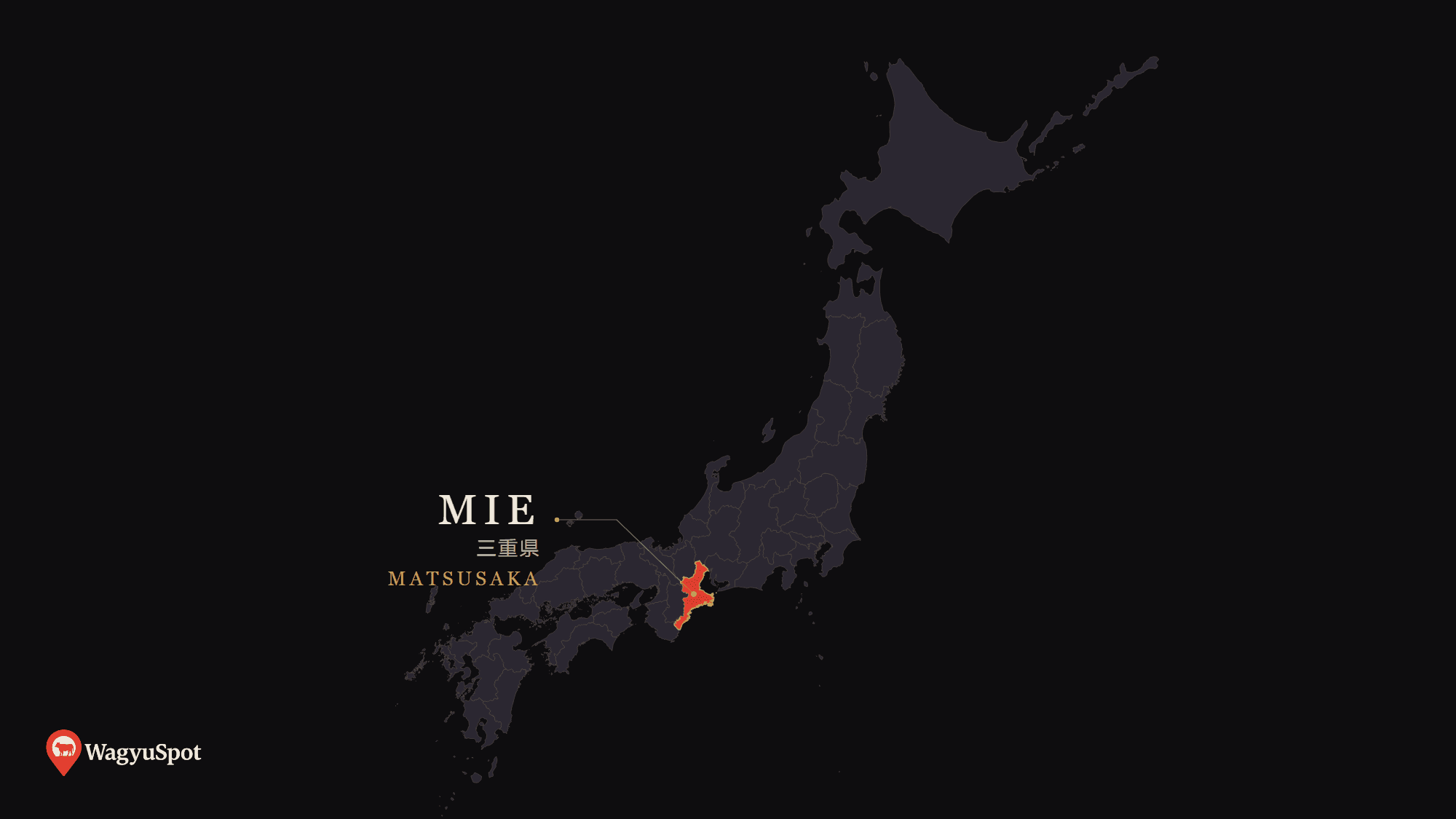
Mie Prefecture's Matsusaka beef, one of the three oldest and most prized Wagyu brands.
- Region
- Matsusaka, Mie (22 municipalities)
- Breed
- Japanese Black, uncalved females only
- Top tier
- Tokusan Matsusaka Ushi, GI No. 25
- Tokusan fattening
- 900 days or more
One name, two standards
Matsusaka beef comes from the area around Matsusaka City in Mie Prefecture, and the single most useful thing to know about it is that the name covers two different standards. Ordinary Matsusaka beef is uncalved female Japanese Black cattle brought into the designated production area, 22 municipalities as they stood in November 2004, by twelve months of age and registered in the Matsusaka Beef Individual Identification Management System. Above that sits a much smaller tier.
That upper tier is Tokusan Matsusaka Ushi, registered under Japan's Geographical Indication scheme as No. 25 to the Matsusaka Beef Liaison Council. Its standard is stricter in two specific ways: the calves must be uncalved females brought in from Hyogo Prefecture before twelve months of age, and they must then be fattened for 900 days or more, roughly thirty months of feeding on top of the animal's first year. Matsusaka City reports that only a few percent of all Matsusaka beef clears it, about four percent in its fiscal 2023 figures. A menu saying "Matsusaka" is almost certainly not saying Tokusan.
The Hyogo connection, and why it matters next to Kobe
The Tokusan requirement that calves come from Hyogo is the detail that connects Matsusaka to Kobe, and it is worth stating precisely because it is easy to overstate. Hyogo is the home of the Tajima bloodline, the closed herd from which Kobe beef is drawn. The top tier of Matsusaka therefore starts from the same prefecture's calf supply and is then finished in Mie for an unusually long time.
It does not follow that Tokusan Matsusaka is Kobe by another name, and nothing on this site treats it that way. Kobe is a separate designation with its own association, its own carcass criteria and its own registry of licensed sellers, and a Matsusaka animal is not eligible for it. The honest summary is that the two brands draw on overlapping genetics and diverge completely in how they are defined: Kobe on carcass criteria in Hyogo, Tokusan Matsusaka on where the calf came from and how long it was fed.
What the standard specifies, and what it leaves to the grade
The Matsusaka standards quoted above turn on breed, sex, calf origin, production area and time. Marbling is described rather than set as a floor, which is a real difference from brands that state a grade minimum, and it is why a Matsusaka claim and a grade claim are two separate pieces of information. Expect a well-documented menu to carry both: the brand name and a Japanese grade such as A5.
Producer material emphasizes fine marbling and fat with a low melting point, attributed to unsaturated fat content. Those are brand characterizations and should not be read as a measured threshold every Matsusaka carcass has cleared. The city cites a champion animal named Yoshitoyo that sold at auction for 50 million yen in 2002, which says something about the top of the market and nothing about a given portion.
The beer-and-massage story
Matsusaka is the source of much of the folklore about pampered Wagyu: cattle given beer to stimulate appetite and massaged by hand. Some Matsusaka farmers have genuinely used these practices, historically to encourage eating during humid summers, but they are best understood as heritage and marketing rather than a universal requirement of the grade.
How to order it with confidence
Every registered Matsusaka animal carries an individual identification number, and that number can be looked up publicly to return its date of birth, pedigree, fattening farmer and shipping date. That is a stronger form of evidence than most Wagyu brands offer, and it is the thing to ask for.
So a claim naming Mie Prefecture, a grade, and an identification number is worth far more than a bare "Matsusaka style" line, which is not a designation at all. If a menu or a seller says Tokusan, that is a specific and checkable claim rather than a flourish, and it should be accompanied by the same paperwork.
Where to eat it3
Alexander's Steakhouse - Cupertino
Cupertino, CA
RPM Steak
Chicago, IL
B-Prime Steakhouse
Atlantic City, NJ
Where to buy it1
Common questions
- What is the difference between Matsusaka beef and Tokusan Matsusaka beef?
- Tokusan Matsusaka Ushi is the top tier, registered as Geographical Indication No. 25. It requires uncalved female calves introduced from Hyogo Prefecture before twelve months of age and fattened for 900 days or more. Ordinary Matsusaka beef is uncalved female Japanese Black registered in the Matsusaka identification system within the designated production area. Matsusaka City reports only about four percent of Matsusaka beef qualifies as Tokusan, so an unqualified "Matsusaka" on a menu is very unlikely to mean the higher tier.
- Are Matsusaka cattle really fed beer and massaged?
- Some farmers have used both practices, traditionally to keep cattle eating in hot, humid weather. They are part of Matsusaka's heritage and marketing rather than a rule that defines the beef, and they are not universal.
- Does Matsusaka beef have to be A5?
- No. The Matsusaka standards turn on breed, sex, calf origin, production area and length of fattening rather than on a stated marbling floor, so the brand name and the grade are two separate claims. A well-documented menu gives you both.
- What makes Matsusaka different from Kobe?
- Both are Japanese Black regional brands with different rules. Kobe requires eligible Tajima cattle and the Kobe association's Hyogo, grade, sex and carcass criteria. Matsusaka comes from its defined Mie production area and centers on uncalved female cattle, with its top tier additionally requiring Hyogo-sourced calves and 900 days of fattening. The two overlap in genetics and not in definition, and a Matsusaka animal is not eligible to be sold as Kobe.
Looking for the U.S. ranches that raise Wagyu? See the farms · The Kobe list · How to spot authentic Wagyu