
Regional brand · Saga
Saga Beef Wagyu
Saga Prefecture Japanese Black held to an unusually strict floor: grade 4 or 5 and BMS No. 7 or above.
- Region
- Saga, Kyushu
- Breed
- Japanese Black (Kuroge)
- Brand name
- Saga-gyu
- Standard
- Grade 4 or 5 with BMS 7 and above
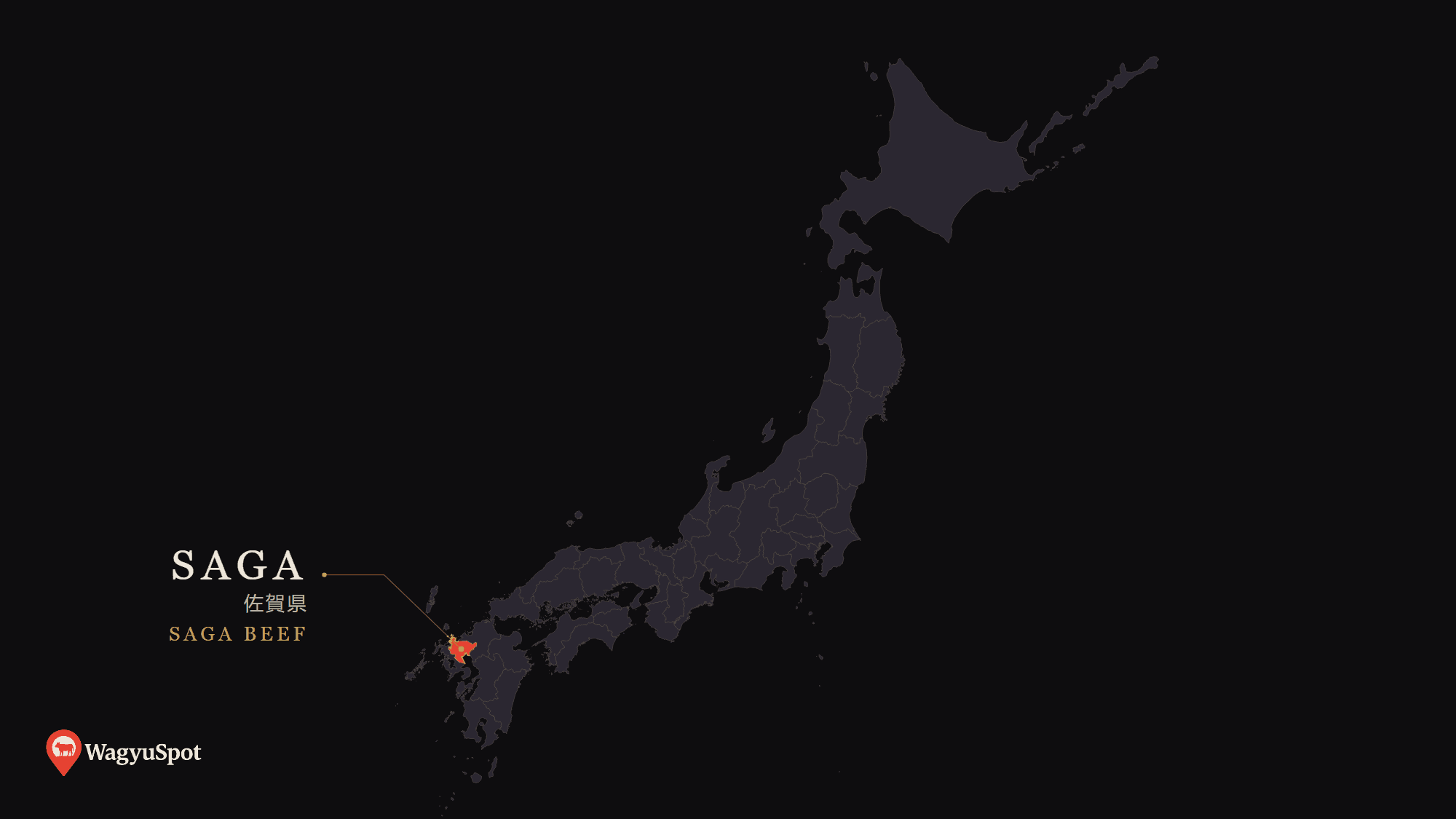
The brand and who certifies it
Saga beef, or Saga-gyu, comes from Saga Prefecture in northwestern Kyushu, the small prefecture between Fukuoka and Nagasaki. The brand is administered through JA Saga, the prefectural agricultural cooperative, and it is limited to Japanese Black cattle fattened by farmers within JA Saga's jurisdiction. That cooperative structure is the defining feature of the brand: the name follows the cooperative rather than a farm or a district.
Grading is carried out by the Japan Meat Grading Association, the national body. Saga beef is the premium tier of the prefecture's output, and cattle that fall below its floor are sold under a separate name, Saga-san Wagyu, so the two labels are not interchangeable even though both come from the same prefecture.
A grade floor that goes beyond the letter grade
Saga beef requires a quality grade of 4 or 5, and, unusually, it adds a second condition on top: the Beef Marbling Standard score must be 7 or higher. BMS is the twelve-point marbling scale that sits underneath the quality grade, and a grade 4 carcass can carry a BMS anywhere from 5 to 7.
The practical effect is that Saga beef excludes grade 4 carcasses at BMS 5 or 6. Those, along with grades 3 and 2, are sold as Saga-san Wagyu instead. The separate BMS floor is the most concrete distinction in the Saga standard.
History
Saga beef is a modern brand rather than a historic one. It grew out of a young farmers' research group that began work on quality improvement in 1983, and the Saga beef name was established the following year, in 1984, with sales starting in Osaka. The name was registered as a trademark in 2000, at a time when trademarking a place name was still rare in Japan.
Exports followed steadily: Hong Kong in 2007, the United States in 2008, Singapore in 2011, Thailand in 2013, the Philippines in 2014, Vietnam in 2015, and Taiwan in 2017. The brand marked its fortieth anniversary in 2024.
Flavour and texture
The BMS floor means Saga beef is consistently and heavily marbled, and it is described in terms of a glossy, fine grain, a soft melting texture, and a mild sweetness in the fat that comes forward with heat. Saga's producers point to the prefecture's mild climate and water as part of the story, which is a claim common to most Japanese regional brands and is better treated as identity than as a testable quality mechanism.
Against Kobe, the comparison is one of definition rather than reputation. Kobe is restricted to Tajima-lineage cattle from Hyogo Prefecture under its own registry and its own certification body. Saga is defined by the cooperative that raised the animal and by a numeric marbling threshold. They are different kinds of rule sets applied to the same breed.
Finding it in the U.S.
For a U.S. Saga beef claim, apply the same evidence test as for another Japanese regional brand: look for Saga Prefecture, the grade, and traceability evidence. Do not infer current U.S. availability or market share from an older export announcement.
Be alert to the distinction between Saga beef and Saga-san Wagyu. Both are real, both come from Saga, and they are separate grades of product. A listing that says only Saga is worth a question.
No matched U.S. venues yet
We don't currently have a published restaurant or retailer matched to Saga Beef Wagyu. The guide remains available so the empty result is transparent as the directory grows.
Browse populated Wagyu guides · Browse the restaurant directory
Common questions
- What grade does Saga beef have to be?
- Quality grade 4 or 5 from the Japan Meat Grading Association, and additionally a Beef Marbling Standard score of 7 or higher. The BMS condition excludes grade 4 carcasses at BMS 5 or 6.
- What is the difference between Saga beef and Saga-san Wagyu?
- Saga-san Wagyu is the label for Saga Prefecture beef that does not reach the Saga beef standard: grade 4 with a BMS of 6 or below, plus grades 3 and 2. Both are genuine Saga products, at different quality tiers.
- Is Saga beef available in the United States?
- For a U.S. Saga beef claim, confirm the named prefecture, grade, and current traceability evidence. Do not infer present availability from an older export date.
- How old is the Saga beef brand?
- The name dates to 1984, following a 1983 quality improvement program by a local young farmers' group. It was trademarked in 2000 and marked forty years in 2024, making it much younger than historic brands such as Omi or Matsusaka.
Looking for the U.S. ranches that raise Wagyu? See the farms · The Kobe list · How to spot authentic Wagyu