
Cuts
Wagyu cuts, decoded
U.S. menus and retailers commonly use familiar steak names alongside Japanese trade and yakiniku names. The systems do not divide every muscle in the same way, and availability also depends on demand, fabrication, import eligibility, freight, and the individual seller.
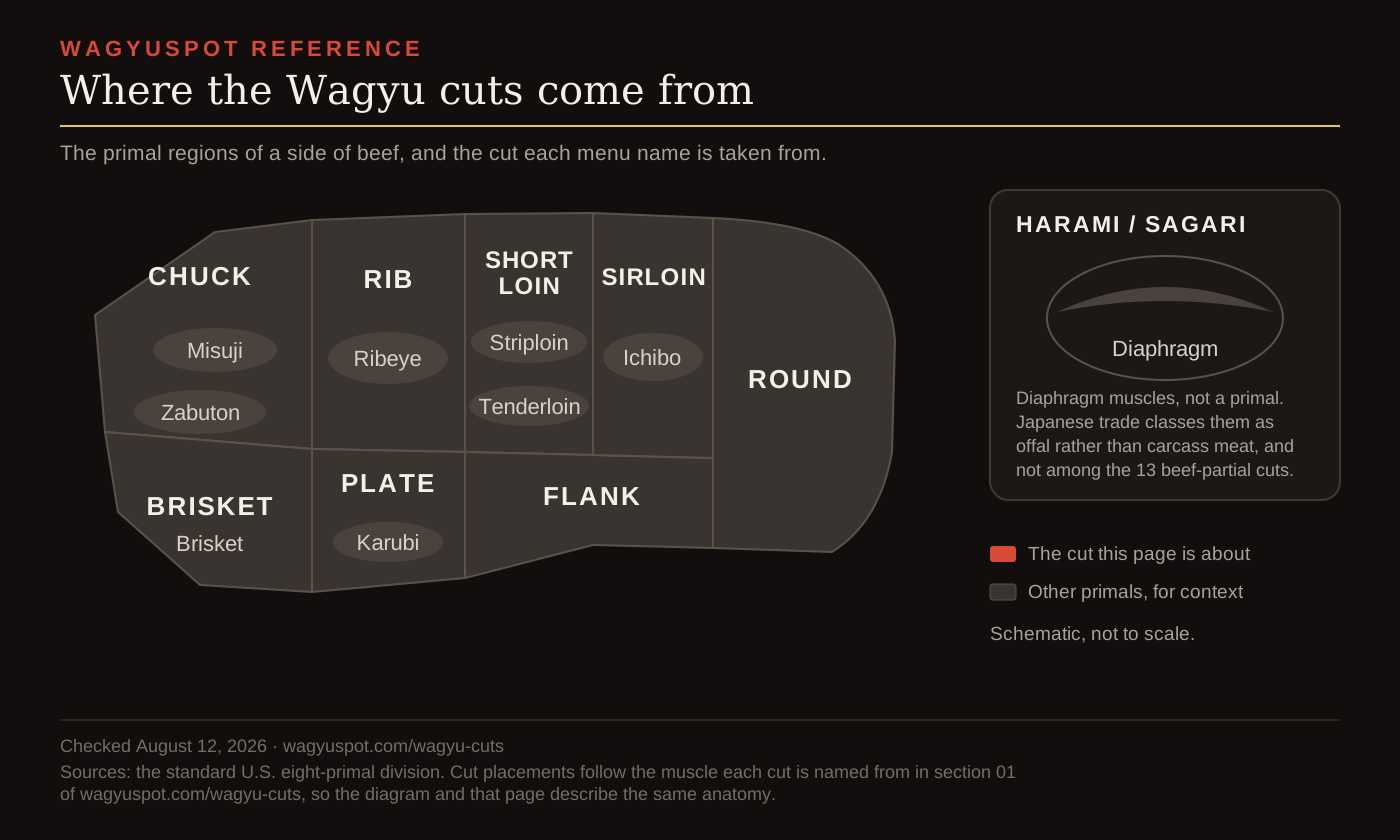
The cuts you will actually see
Common names on U.S. Wagyu menus and retail pages, with a Japanese term where the relationship is useful:
- Ribeye · リブロース ribu-rosu
A common showcase cut because the Japanese marbling assessment is made at a ribeye cross-section. The rib cap, the crescent of spinalis dorsi on top, may also be separated and sold on its own. More on Wagyu ribeye
- Tomahawk
A ribeye left attached to the whole rib bone, with the bone scraped clean so it resembles an axe. It is a presentation rather than a separate cut, so the beef is the same muscle described above. The practical caution is weight: a large share of an advertised tomahawk weight is bone, so ask the trimmed weight before comparing its price against a boneless steak. The long bone also makes it awkward to cook evenly, which is why it is usually finished in an oven or over indirect heat rather than seared through. More on Wagyu ribeye
- Striploin · サーロイン sarloin
Often firmer than ribeye, with marbling distributed through the longissimus muscle. See section 02: the Japanese use of “sirloin” aligns more closely with the U.S. strip loin than with the American sirloin primal. Fabrication specifications can vary, so compare the seller's cut description rather than relying on the name alone. More on Wagyu striploin
- Tenderloin · ヒレ hire
Valued for tenderness and typically less visibly marbled than the rib and strip loin. The carcass grade still applies, but the tenderloin is not separately marbling-graded. More on Wagyu tenderloin
- Zabuton · ザブトン
“Cushion.” Chuck, built around the serratus ventralis under the shoulder blade. It overlaps with what U.S. sellers commonly market as a Denver steak, though fabrication can differ. More on Wagyu zabuton
- Misuji · ミスジ
“Three lines,” for the striations in cross-section. It is cut from the infraspinatus in the shoulder. Exact yield and fabrication vary. Choose doneness to taste while following USDA guidance for whole beef steaks: 145F and a three-minute rest. More on Wagyu misuji
- Karubi · カルビ
A menu term associated with short-rib and belly cuts sliced for yakiniku. The name derives from Korean galbi. Naka-ochi karubi refers to intercostal meat from between the rib bones. Thin slices cook quickly, but time and color are not food-safety tests. More on Wagyu karubi
- Harami and sagari · ハラミ・サガリ
Two different diaphragm muscles, not one cut: harami is the costal diaphragm, while sagari refers to the crura and is commonly compared with hanger steak. Japanese trade classification treats these diaphragm cuts as offal rather than carcass meat. They do not appear among the 13 standard beef-partial cuts. More on Wagyu harami
- Ichibo · イチボ
The sirloin-cap region, related to the cut commonly sold as picanha. Exact fabrication and retained fat can vary by seller. More on Wagyu ichibo
- Brisket
U.S.-style smoked brisket appears more often in American Wagyu offerings. Japanese fabrication and menus may describe portions from the plate or short-plate region with バラ (bara) names, but country alone does not determine how a cut is fabricated or served. More on Wagyu brisket
The sirloin trap
The most useful thing on this page for anyone reading a menu. What Japan calls サーロイン is what America calls strip loin, NAMP 180, the New York strip. It is not the American sirloin.
The American sirloin corresponds most closely to Japanese らんいち ran-ichi, which is one of the 13 official cuts and divides into ランプ ranpu as the top sirloin and イチボ ichiboas the cap. The match is approximate: the US sirloin also takes in bottom-sirloin cuts like tri-tip that らんいち does not. So “Japanese sirloin” on a menu refers to a loin cut, while “sirloin” in U.S. fabrication refers to a different region toward the hip.
The grade was measured in one place
This is the most under-explained fact in Wagyu, and it changes how you should read every cut description.
Marbling is judged at a single cross-section, and the two systems do not cut at the same place. Japan opens the carcass between the 6th and 7th rib. The US ribs between the 12th and 13th. Neither re-scores marbling at the loin, the chuck or the round: one face is read, and the resulting marbling verdict stands for the whole animal. Other factors do range wider, and Japan’s fat assessment in particular looks at the whole carcass, but the marbling number that drives the grade comes from one spot.
So an A5 tenderloin was not separately assessed for marbling. The carcass carries a grade based in part on the ribeye assessment, while visible marbling can differ among muscles and locations.
The practical consequence is that a carcass grade does not promise identical visible marbling in every muscle. There is also no official JMGA-to-USDA conversion: the systems use different assessment sites, terminology, and decision rules, so vendor crosswalks are comparisons rather than official equivalences.
Official cuts and trade names
You will read that Japanese butchery recognizes 30 or more official cuts against America’s eight primals. That is not right, and the true version is more interesting.
Japan’s national partial-meat transaction standard lists 13 beef cuts. Names such as ミスジ, ザブトン, カイノミ, and とうがらし subdivide those broader categories in trade and restaurant use. Likewise, the U.S. system has many subprimals and portion cuts below its familiar primal names.
Fabrication can follow bones, commercial specifications, or muscle seams depending on the product. Yakiniku and specialty butchery often name smaller muscles, while U.S. IMPS also defines detailed subprimal and portion-cut specifications. Comparing “13 cuts” with “eight primals” therefore compares different levels of two systems.
Carcass yield is not one fixed table
A carcass produces much more than rib and loin steaks, but there is no universal pound-by-pound yield table. Live weight, carcass weight, trim level, bone-in versus boneless fabrication, fatness, and the cutting plan all change the result.
The dependable point is narrower: premium middle meats are a limited part of the carcass, while chuck, round, plate, brisket, trim, fat, and bone account for much of the rest. Export demand concentrated on a few premium cuts does not make the other material disappear; it must be sold into other markets and formats.
Why availability differs
No official cut-level export table gives one complete explanation. Relevant factors include:
- Tariff and freight affect cuts differently
Japan sits in the “other countries” quota pool, which was cut from 65,005 to 52,005 tonnes at the start of 2026 and so fills faster. Inside the quota the duty is a weight charge, 4.4 cents per kilo. Outside it, the rate jumps to 26.4 percent of value. That percentage produces the largest absolute duty on high-value cuts. By contrast, fixed per-kilo freight and handling consume a larger share of the selling price for low-value cuts.
- Freight does not care what it carries
Freight and handling charged by weight do not automatically fall with a cut’s market value. Lower-value cuts can therefore have less margin available to absorb logistics, even when their percentage-based tariff bill is smaller.
- Japan wants those cuts
Domestic uses such as yakiniku, shabu-shabu, and sukiyaki can support demand for thin-sliced, chuck, plate, and offal products that an exporter might otherwise sell.
- The volumes are small to begin with
Japan's beef exports are small relative to total U.S. beef supply, and only a share of Japan's exports reaches the United States. That constrains how many cuts can support a durable export channel.
How quickly that pool empties is what turns a structure into a price. Japan is one of several small exporters sharing it with Brazil, which takes very nearly all of it: trade reporting put Brazilian shipments at roughly three quarters of the 2026 pool within the first five days of January, with the rest expected to go within days, and the 2025 pool triggered after about seventeen days. Japan has no carve-out of the kind other suppliers have negotiated. So for a Japanese cut, the out-of-quota rate is the ordinary case for most of any given year rather than an exception at the margin. Beef Central, 12 January 2026
An honesty note. We could not find a MAFF or JETRO table breaking Japanese beef exports down by cut. That loin cuts dominate what reaches the US is an inference from the tariff structure, freight economics and domestic demand, all three of which are sourced. It is an inference, not a published cut-level statistic.
Kobe is a separate supply claim
Kobe is not a cut or a synonym for A5. It is an association-controlled Hyogo brand with lineage, production, grade, sex, and carcass requirements. A Kobe claim therefore needs its own authorization and traceability evidence regardless of whether the menu says ribeye, tenderloin, or burger.
The official venue registry changes, as do menus and inventory. Our Kobe collection is built against the official registry, and a venue earns the badge only when it is on that registry and Kobe appears on its current menu.
Offal eligibility is product-specific
It is too broad to say either that all Japanese beef offal is banned or that every edible organ is admissible. Import eligibility turns on the exact product, current APHIS animal-health requirements, FSIS recognition of the country and slaughter establishment, and the wording of the export certificate.
Japan’s negligible-risk BSE classification does not by itself answer a product-admissibility question. WagyuSpot could not substantiate the previous cut-by-cut eligible and excluded lists from a current U.S. import authority, so we have removed them. Importers should use the current USDA APHIS requirements and FSIS Import & Export Library for the product and establishment involved.
Legal eligibility is also different from commercial availability. Shelf life, food-safety controls, plant approvals, freight, domestic demand, and distributor demand can all affect whether an eligible product is actually exported. Without shipment data, those are plausible factors rather than a proved explanation for a particular missing cut.
Sendai's gyutan trade has long used imported tongue, including U.S. supply, so the dish's regional identity should not be read as a guarantee that the tongue itself is Japanese. Product origin still needs to be checked.
Match the premium to the method
Cooking method changes how much of a marbling premium remains perceptible. Long cooking can render substantial fat, while naturally lean muscles may not resemble a highly marbled ribeye even when they come from the same graded carcass.
Whether that makes a cut worth its price is a preference, not an objective defect. Judge the cut and method you intend to use rather than assuming the carcass grade produces the same result everywhere.
Reading a label or a menu
The terms that carry meaning, and the ones that do not:
- Fullblood
In the American Wagyu Association's USDA-hosted branded-program specification, 100 percent Wagyu with the required registration and DNA parent verification.
- Purebred
In that same specification, at least 93.75 percent Wagyu with the required registration and DNA parent verification. It remains a different category from fullblood.
- F1, F2, F3
Generation shorthand whose exact meaning depends on the mating sequence and the program. F1 commonly identifies a first-generation cross, but later labels should not be converted into a percentage without the parents or pedigree record.
- “American Wagyu”
A broad market term that can cover animals with different breed percentages and crosses. It does not by itself state fullblood, purebred, F1, grade, or producer.
- “Kobe-style”
Not Kobe certification. On inspected labels, geographic terms may require qualifiers such as “style” or “type”; restaurant-menu rules differ. The phrase can describe a style, but it does not establish Hyogo origin or Kobe authorization.
- The Universal Wagyu Mark
A cow’s-head logo administered by the Japan Livestock Products Export Promotion Council. Its current eligibility covers Japan’s four recognized breeds and permitted crosses, with Japanese birth and raising verified through the traceability and registration systems. It does not state a carcass grade or certify Kobe.
One myth to retire. The repeated 46.875 percent figure is not a universal USDA minimum for every Wagyu claim. The USDA-hosted American Wagyu Association specification has a defined scope: approved branded-beef programs claiming Wagyu influence. Within that program, the influence tier traces to at least one registered Wagyu parent. Federally inspected labels must still be truthful and supported; restaurant-menu wording is a separate context.
USDA AMS also publishes the voluntary G-162 “Authentic Wagyu Beef Program,” effective January 2025. It applies to carcasses presented for paid AMS certification and requires qualifying genotype documentation, steer or heifer carcasses, U.S. Prime, and a minimum Moderately Abundant 00 marbling score, among other conditions. It is a specific certification program, not the legal definition of every U.S. Wagyu claim. Restaurant-menu wording is governed in a different context from federally inspected package labels.
How much to buy
Portioning is a planning choice, not a grading standard. A small tasting can help when trying an unfamiliar, highly marbled product, but the cut, actual marbling, menu format, side dishes, and diners matter more than the country label.
- A5 as a main
A 2 to 4 oz tasting range per person is one useful starting point, not a required serving size.
- A5 as a course or appetizer
Multi-course menus commonly use smaller portions; size the course in relation to the rest of the meal.
- American Wagyu
Product-dependent. American Wagyu covers a wide range of breed status, cuts, marbling, and serving formats.
- Thin-sliced formats
Plan by the complete meal and number of diners; there is no universal shabu-shabu or yakiniku portion.
Common questions
- What is the best cut of Wagyu?
- There is no objective best cut. Ribeye and strip loin usually display marbling more directly, tenderloin emphasizes tenderness, and shoulder cuts such as zabuton or misuji offer different textures. Compare the cut, grade, portion, and price rather than treating one as universally superior.
- Is Japanese sirloin the same as American sirloin?
- No, and this trips up a lot of buyers. What Japan calls sarloin is what the US calls strip loin, NAMP 180. The American sirloin is a different part of the animal, corresponding roughly to Japanese ran-ichi, which divides into ranpu as the top sirloin and ichibo as the cap. A Japanese sirloin is a premium loin cut, not the cheaper American sirloin.
- Why is A5 Wagyu tenderloin less marbled?
- Marbling varies among muscles. Japan assesses marbling at the ribeye cross-section between the sixth and seventh ribs and assigns the carcass grade from that assessment; it does not separately grade the tenderloin. A5 therefore does not promise that every cut from the carcass has the same visible marbling.
- Why are some Japanese Wagyu cuts less common in the U.S.?
- Availability can reflect exporter demand, domestic Japanese demand, plant and product eligibility, shelf life, freight, and tariffs. Out-of-quota Japanese beef currently faces a 26.4 percent ad valorem duty, while weight-based logistics can consume a larger share of a lower-value cut's price. No official cut-level export table supports one universal explanation.
- Does the USDA require a minimum percentage to call beef Wagyu?
- There is no single USDA Wagyu quality grade or universal percentage rule for every use of the term. Federally inspected labels must be truthful and substantiated. Separately, the American Wagyu Association's USDA-hosted specification for approved Wagyu-influence programs accepts cattle traceable to at least one registered Wagyu parent; that program rule is not a universal menu definition.
- Is Japanese beef tongue banned from the US?
- Do not rely on a blanket yes or no. Admissibility depends on the exact product, current APHIS animal-health conditions, FSIS country and establishment eligibility, and the required export certificate. We could not support the former cut-by-cut list with a current US import source, so buyers and importers should check the USDA import library for the specific product.
- How much Wagyu should I buy per person?
- Portion size is a menu decision, not a grading rule. For highly marbled A5, two to four ounces per person is a common tasting range, but the appropriate amount depends on the cut, actual marbling, other courses, and diners. American Wagyu varies too widely for one dependable portion rule.
Primary references
- Japan Meat Information Service Center, 13-cut partial-meat transaction standard
- USDA AMS Institutional Meat Purchase Specifications
- Universal Wagyu Mark eligibility and usage
- Kobe Beef Marketing & Distribution Promotion Association criteria
- 2026 U.S. beef tariff-rate quota allocation
- USDA FSIS Import & Export Library for current product and establishment eligibility
- USDA AMS G-162 Authentic Wagyu Beef Program