
Regional brand · Kagawa
Olive Wagyu
Kagawa's Sanuki cattle finished on spent olive pulp, among the rarest Wagyu in Japan and produced in tiny numbers.
- Region
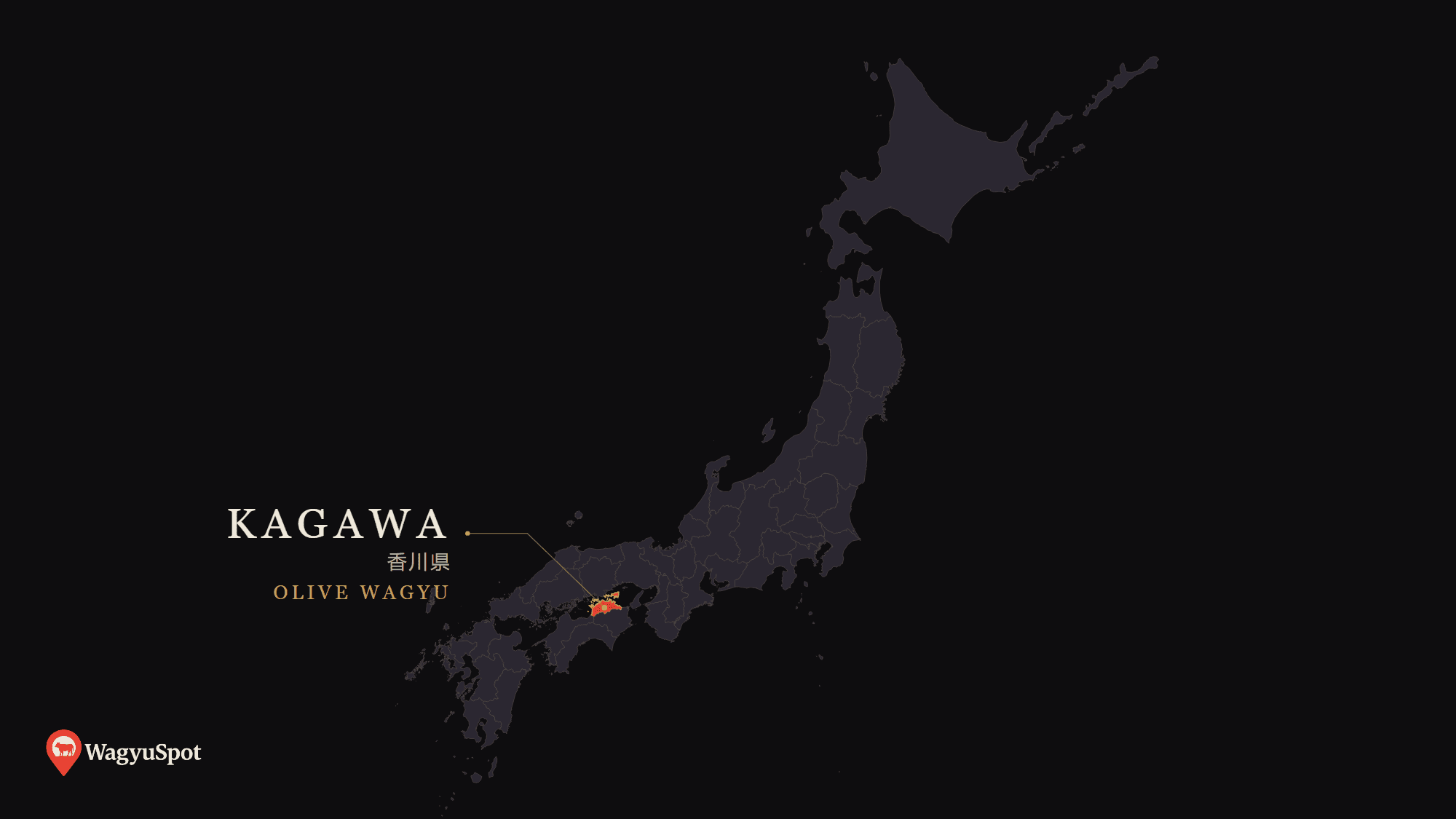
- Kagawa (Sanuki), Shikoku
- Breed
- Japanese Black (Kuroge)
- Feed rule
- 100g+ per head daily, 2 months+ pre-shipping
- Trademarked
- 29 July 2011
What the name actually certifies
Olive Wagyu is a feeding designation layered on top of an existing prefectural brand, and knowing that is most of what protects you from overpaying for the wrong thing. The underlying brand is Sanuki Wagyu, Kagawa Prefecture's Japanese Black. Olive Wagyu is Sanuki Wagyu that has additionally been fed olive feed at 100 grams or more per head per day for at least the two months before shipping. That standard, published in a 2017 report by Japan's Agriculture and Livestock Industries Corporation, is unusually specific for a Wagyu brand, and it is checkable.
Two things follow from it that marketing copy tends to blur. The first is that these are not cattle raised on olives: the rule describes a finishing supplement over a defined window, not a lifetime diet. The second is that Olive Wagyu, by itself, says nothing about marbling. It is a statement about feed. The grade is a separate claim, and it comes from the Sanuki label rather than the olive one.
Gold, Silver, and where the grade comes from
Sanuki Wagyu was trademarked on 14 October 1988 and covers Japanese Black of clear pedigree fattened within Kagawa, whose carcass falls in yield grade A or B under the Japan Meat Grading Association standard. Within that, quality grade 5 or 4 earns the Gold label and quality grade 3 earns the Silver label. Olive Wagyu was trademarked more than two decades later, on 29 July 2011.
So the useful question to ask a seller is not whether the beef is Olive Wagyu but which label it carries. A Silver-label Olive Wagyu is a grade 3 carcass that met the olive feeding rule, and that is a genuinely different product from a Gold-label one, even though both may be sold under the same evocative name at a similar premium. Nothing about the olive feed lifts a carcass into a higher grade.
Where it came from
The olive pulp is the lees left after pressing olives for oil on Shodoshima, the island that produces most of Japan's olive oil, dried and toasted before feeding. A Shodoshima cattle farmer named Masaki Ishii began experimenting with the idea around 2006, inspired by traditional persimmon-drying, and it took him roughly three years to find a way of toasting the pulp that cattle would actually eat.
The brand's own account has it launching in 2010 with three farms, expanding to about thirty as a prefectural brand in 2011, and the Sanuki Wagyu and Olive Wagyu Promotion Association forming in 2012. Olive Wagyu reached the United States around 2018.
On rarity and the oleic acid claim
Producers and importers describe Olive Wagyu as a small-production line and publish changing herd or harvest counts. Those figures should be treated as dated producer reports rather than a measured claim that it is the world's rarest beef, and the scarcity is better understood from the structure of the thing: the feed supply is tied to one island's olive-oil pressing, and the qualifying window is the last two months before shipping.
Producers also report that olive feeding changes the beef's fatty-acid profile, including oleic acid. Oleic acid can be relevant to fat softness, but it is not a measure of umami, which is associated with taste compounds such as glutamate and nucleotides. Descriptions such as sweeter or more savory are sensory and producer claims rather than consequences proved by an oleic-acid percentage.
How to order it with confidence
Ask for three things: the Sanuki Olive Wagyu name, Kagawa origin, and the Gold or Silver label. Those are checkable product claims. A price, a rarity statement, or a photograph of an olive grove is not proof of any of them, and a menu that says Olive Wagyu without a label is telling you about the feed while leaving out the grade.
Where to eat it21
Toca Madera - Scottsdale
Scottsdale, AZ
The Pines Modern Steakhouse
Highland, CA
Alexander's Steakhouse - Pasadena
Pasadena, CA
Toca Madera - Las Vegas
Las Vegas, NV
Nicco's
Las Vegas, NV
The Lobster Club
New York, NY
Palladino's NYC Steak & Seafood
New York, NY
Barclay Prime
Philadelphia, PA
Dee Lincoln Prime Steakhouse
Frisco, TX
Toca Madera - Houston
Houston, TX
Bourbon Boulevard
Chantilly, VA
The Metropolitan Grill
Seattle, WA
The Wagyu House by Meat N' Bone
Hallandale Beach, FL
Prime & Provisions
Chicago, IL
Anthony's Chophouse
Carmel, IN
Hiroki-san
Detroit, MI
Morimoto
Philadelphia, PA
Kayne Prime
Nashville, TN
Prime 131
Houston, TX
Catch LA
West Hollywood, CA
CUT by Wolfgang Puck - Las Vegas
Las Vegas, NV
Where to buy it7
Holy Grail Steak Co.
Japanese A5 (Kobe, Ogata, Omi, Takamori, Miyazaki, Kagoshima, Sendai), American (Tajima, Akaushi), Australian (Carrara)
Crowd Cow
Japanese A5 (Kagoshima, Miyazaki, Hokkaido, Iwate, Olive/Shodoshima), American Wagyu (Mishima Reserve)
The Wagyu Shop
Japanese A5 (Hokkaido, Kobe, Miyazakigyu, Motobu Gyu, Olive Wagyu, Takamori), American, Australian
Ligma Provisions
Japanese A5/A4/A3/F1 across Aomori, Hokkaido, Hyogo, Kagoshima, Kumamoto, Mie, Miyagi, Miyazaki, Nagano, Oita, Saitama, Shiga, Shimane, Shodoshima and Yamaguchi; Australian Wagyu graded by BMS label (Blue 9+, Gold 8/9, Silver 6/7, Green 4/5); USDA Prime; grass-fed
Wagshal's Market
Japanese A5 (olive-fed)
J. Morten's
Japanese A5, Australian
Pursuit Farms
Japanese A3/A4/A5 by named brand (Kobe, Ohmi, Hokkaido Snow, Olive, Sendai Gyu, Shichiri from Hida, Ozaki, Mizusako), Australian, own-ranch American
Common questions
- Are Olive Wagyu cattle raised on olives?
- No. The standard requires olive feed at 100 grams or more per head per day for at least the two months before shipping. It is a finishing supplement over a defined window rather than a lifetime diet, and the olives are spent pulp left over from pressing oil on Shodoshima, dried and toasted.
- Does Olive Wagyu mean a high grade?
- Not by itself. Olive Wagyu certifies the feed. The grade comes from the underlying Sanuki Wagyu label: yield grade A or B, with quality grade 5 or 4 earning the Gold label and quality grade 3 earning Silver. Ask which label the beef carries.
- What is the difference between Sanuki Wagyu and Olive Wagyu?
- Sanuki Wagyu is Kagawa Prefecture's Japanese Black brand, trademarked in 1988. Olive Wagyu, trademarked in 2011, is a subset of it that also met the olive feeding rule. Every Olive Wagyu animal is a Sanuki Wagyu animal; the reverse is not true.
- Is Olive Wagyu the rarest beef in the world?
- "Rarest in the world" is a marketing claim without a common measurement across brands. Olive Wagyu is a small-production line according to its producers, but any exact herd or monthly harvest figure needs a date and source.
Looking for the U.S. ranches that raise Wagyu? See the farms · The Kobe list · How to spot authentic Wagyu