
Prefecture · Kagoshima
Kagoshima Wagyu
Kagoshima (Satsuma) Prefecture, Japan's largest Wagyu-producing region.
- Region
- Kagoshima (Satsuma), Kyushu
- Breed
- Japanese Black (Kuroge)
- Brand name
- Kagoshima Kuroushi
- Scale
- Major Japanese Black production area
- Wagyu Olympics
- Overall team champion 2017 and 2022
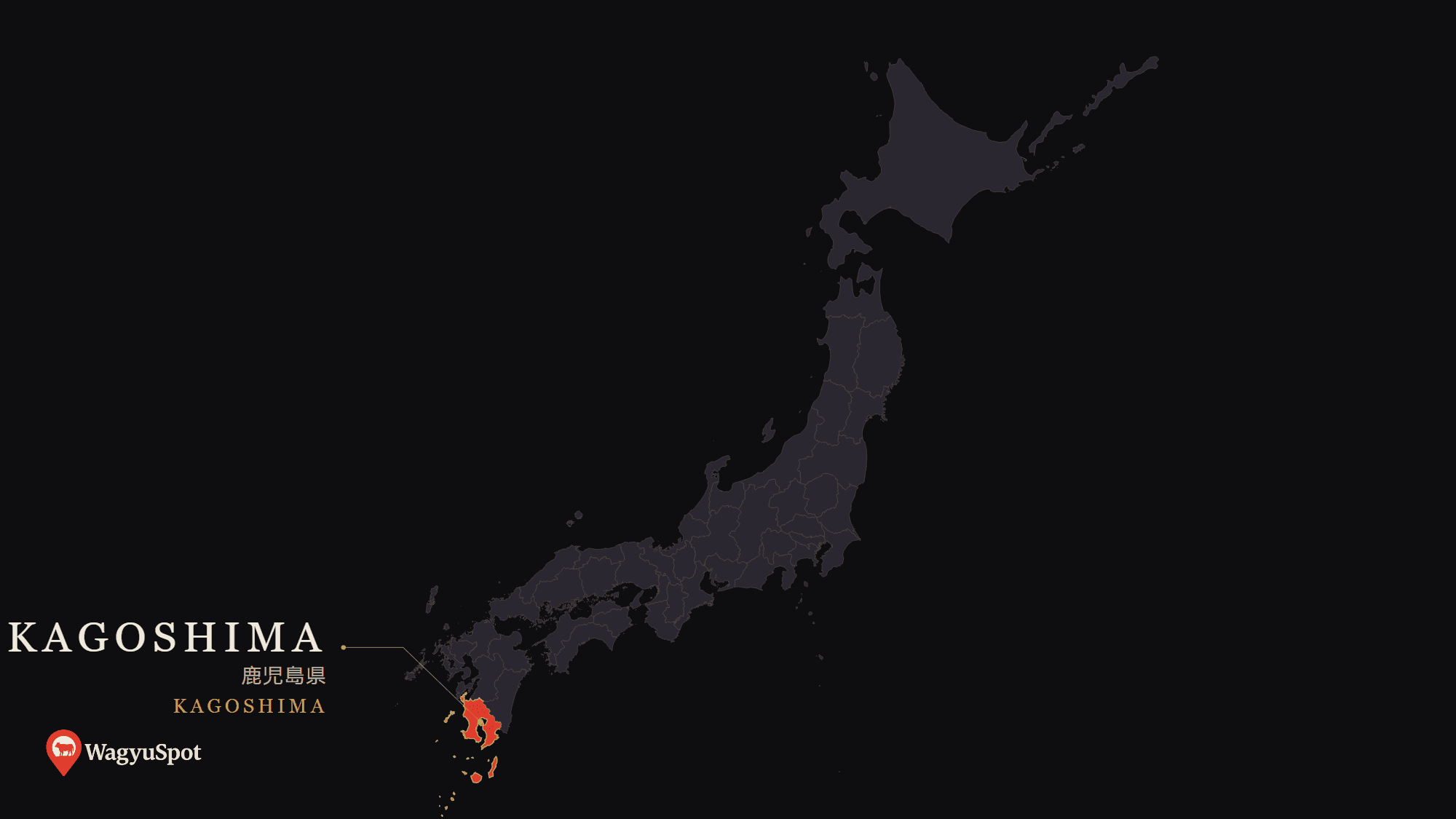
The prefecture
Kagoshima occupies the southern tip of Kyushu, the region historically known as Satsuma. It is a major Japanese Black production area, and its beef is sold under the Kagoshima Kuroushi brand, usually rendered in English as Kagoshima Wagyu or Kagoshima black beef. Herd shares and rankings are time-sensitive and need a dated livestock source.
Cattle have been part of the region for centuries. Before the modern breed was consolidated, Kagoshima kept several distinct local strains, among them Hashima, Kaseda, and Tanegashima cattle, and generations of selective breeding drew those lines into the Japanese Black herd the prefecture raises today.
What the Kagoshima name requires
Kagoshima Kuroushi is a prefectural brand covering Japanese Black cattle fattened in Kagoshima, certified by the Kagoshima Prefecture Beef Cattle Promotion Council. It was registered under Japan's Geographical Indication system as GI number 58 on 15 December 2017, the same day Miyazaki's brand was registered.
Because it is a prefecture-wide standard spanning a very large number of farms, a Kagoshima label describes origin and grade rather than a single ranch. The brand includes large vertically integrated producers such as the Kamichiku group alongside small family operations. Japan's agriculture ministry describes the beef as fine-grained and tender with well-balanced marbling.
Quality control in the prefecture is organized rather than incidental. A prefectural beef cattle promotion council was established in 1995 to standardize feeding management and feed composition across fattening farms, working alongside the prefecture's beef cattle improvement research institute and its sire association.
The competition record
Kagoshima has won the overall team championship at the last two National Competitive Exhibitions of Wagyu, the once-every-five-years event often called the Wagyu Olympics, taking the top prefectural result in Miyagi in 2017 and again in Kagoshima in 2022.
The 2022 exhibition, held in Kirishima and Minamikyushu in October with 438 head entered from across the country, was the stronger of the two performances. Kagoshima took first place in six of the nine judged divisions and won the Prime Minister's Award in the breeding cattle division, the honor given for body shape, growth, and sustained improvement across generations.
It is worth separating these results from Miyazaki's. The exhibition issues separate top awards for breeding cattle and for meat cattle, plus an overall team result. Kagoshima's 2017 win was the overall team championship, while Miyazaki took the meat cattle division that year and Oita took the breeding cattle division. Both prefectures can accurately describe 2017 as a winning year, and U.S. retailer copy that flatly calls Kagoshima the 2017 Wagyu Olympics winner is describing the team result.
Kagoshima and Kobe compared
Kobe is defined much more narrowly. It requires eligible Tajima cattle born, raised, and slaughtered in Hyogo Prefecture, restricted to bullocks and uncalved heifers, with BMS 6 or higher, meat quality grade 4 or 5, yield grade A or B, and a carcass weight no greater than 499.9 kilograms, certified by the Kobe Beef Marketing and Distribution Promotion Association. Kagoshima Kuroushi is a prefectural origin brand for Japanese Black fattened in Kagoshima, graded on the same national scale but without Kobe's single-lineage and carcass-weight limits.
The difference in scale is a useful contrast: Kagoshima accounts for a substantial share of Japan's Japanese Black herd, while certified Kobe is drawn from Tajima cattle under Hyogo's separate standard. That does not create a universal price ordering; compare like cuts and grades on the same date.
For a diner comparing two cuts, the grade and marbling score carry more information than the brand names. A Kagoshima A5 cut at a high marbling score can be more heavily marbled than a Kobe cut sitting at the lower end of the Kobe standard.
What it costs in the United States
Kagoshima pricing varies by cut, BMS, portion size, retailer, exchange rate, and shipping. Brand alone does not establish that it will cost less than Kobe or another prefecture on a particular date. Use the comparison method in our Wagyu price guide, and do not compare a restaurant's prepared per-ounce price directly with raw retail price per pound.
How to order it with confidence
Look for the Kagoshima or Kagoshima Kuroushi name with a stated Japanese grade. The prefecture, grade, and traceability evidence are separate facts; public disclosure gives the customer more to check than the word Wagyu alone.
Kagoshima is a large brand covering many farms, so the grade and marbling score tell you more about a specific cut than the prefecture name alone. Producer names such as Kamichiku sometimes appear on U.S. listings, and those are worth treating as retailer marketing unless the seller can tie them to the prefecture of origin and the grade.
Where to eat it101
Alexander's Steakhouse - Cupertino
Cupertino, CA
SushiSamba Los Angeles
West Hollywood, CA
Old Florida Fish House
Santa Rosa Beach, FL
PALM BEACH MEATS
West Palm Beach, FL
Prime & Providence
West Des Moines, IA
Rare Steakhouse
Everett, MA
SUSHISAMBA VEGAS
Las Vegas, NV
Bazaar Meat by José Andrés
Las Vegas, NV
WAKUDA
Las Vegas, NV
Vic & Anthony's - Las Vegas
Las Vegas, NV
The Bazaar by Jose Andres New York, Nomad
New York, NY
KATAMI
Houston, TX
Dee Lincoln Prime Steakhouse
Frisco, TX
B&B Butchers & Restaurant - Houston
Houston, TX
The Metropolitan Grill
Seattle, WA
BOA Steakhouse - West Hollywood
West Hollywood, CA
BOA Steakhouse - Santa Monica
Santa Monica, CA
BOA Steakhouse - Manhattan Beach
Manhattan Beach, CA
Niku Steakhouse
San Francisco, CA
Ozumo San Francisco
San Francisco, CA
Lucky Mizu
Los Angeles, CA
The Brothers Sushi (Woodland Hills)
Woodland Hills, CA
Sukai Teppanyaki
Friant, CA
Flagstaff House
Boulder, CO
MILA
Miami Beach, FL
O-Ku Alys Beach
Alys Beach, FL
Japanese Bocce Club (The Boca Raton)
Boca Raton, FL
The Wagyu House by Meat N' Bone
Hallandale Beach, FL
Cowford Chophouse
Jacksonville, FL
O-Ku Tampa
Tampa, FL
Japanese BBQ Yoshi
Honolulu, HI
The Brickyard
Boise, ID
Benny's Chop House
Chicago, IL
Butcher & The Bear
Chicago, IL
Grill 23 & Bar
Boston, MA
Youji's #WashokuRenaissance
Charlestown, MA
Mooo.... Restaurant
Boston, MA
Blue Ribbon Sushi
Boston, MA
1587 Prime
Kansas City, MO
O-Ku Raleigh
Raleigh, NC
Casa Bovina
Lincoln, NE
BOA Steakhouse - Las Vegas
Las Vegas, NV
Jean Georges Steakhouse
Las Vegas, NV
Bowery Meat Company
New York, NY
HARU Omakase
Columbus, OH
Porch and Parlor
Memphis, TN
Bourbon Steak - Nashville
Nashville, TN
Oak Steakhouse Nashville
Nashville, TN
Monarch
Dallas, TX
Dakota's Steakhouse
Dallas, TX
1700 Degrees Steakhouse
El Paso, TX
J-Prime Steakhouse
San Antonio, TX
Blu Prime Steakhouse (BLU Prime)
San Antonio, TX
Vic & Anthony's - Houston
Houston, TX
BOA Steakhouse
Austin, TX
J-Prime Steakhouse - Austin
Austin, TX
Apex
Park City, UT
Oak Steakhouse
Alexandria, VA
Meet Korean BBQ
Seattle, WA
Fleming's Prime Steakhouse & Wine Bar - Birmingham (Summit)
Birmingham, AL
STK Steakhouse - Scottsdale
Scottsdale, AZ
STK Steakhouse - Phoenix
Phoenix, AZ
Kojima
Los Angeles, CA
Haidilao Hot Pot (Irvine)
Irvine, CA
STK Steakhouse - Topanga
Canoga Park, CA
STK Steakhouse - Los Angeles
Los Angeles, CA
STK Steakhouse - San Francisco
San Francisco, CA
STK Steakhouse - Denver
Denver, CO
STK Steakhouse Washington DC
Washington, DC
Fleming's Prime Steakhouse - Tampa
Tampa, FL
STK Steakhouse - South Beach
Miami Beach, FL
Fleming's Prime Steakhouse - Sarasota
Sarasota, FL
STK Steakhouse - Aventura
Aventura, FL
Fleming's Prime Steakhouse - Fort Lauderdale
Fort Lauderdale, FL
STK Steakhouse - Atlanta
Atlanta, GA
Fleming's Prime Steakhouse & Wine Bar
West Des Moines, IA
STK Steakhouse - Oak Brook
Oak Brook, IL
STK Steakhouse - Chicago
Chicago, IL
Adalina Prime
Chicago, IL
STK Steakhouse - Boston
Boston, MA
Fleming’s Prime Steakhouse (Birmingham)
Birmingham, MI
STK Steakhouse - Charlotte
Charlotte, NC
Fleming's Prime Steakhouse & Wine Bar - Raleigh
Raleigh, NC
Fleming's Prime Steakhouse & Wine Bar - Charlotte
Charlotte, NC
Fleming's Prime Steakhouse & Wine Bar
Omaha, NE
STK Steakhouse - Midtown
New York, NY
STK Steakhouse - Chelsea
New York, NY
Gui Steakhouse
New York, NY
Fleming's Prime Steakhouse & Wine Bar - Dayton
Dayton, OH
Fleming's Prime Steakhouse & Wine Bar
Nashville, TN
STK Steakhouse
Nashville, TN
Fleming's Prime Steakhouse & Wine Bar - Knoxville
Knoxville, TN
Killen's Steakhouse
Pearland, TX
STK Steakhouse - Dallas
Dallas, TX
Fleming's Prime Steakhouse & Wine Bar (The Domain)
Austin, TX
Grace
Fort Worth, TX
Sushi Horiuchi
Houston, TX
Fleming's Prime Steakhouse & Wine Bar
Salt Lake City, UT
STK Steakhouse
Salt Lake City, UT
Fleming's Prime Steakhouse & Wine Bar
McLean, VA
Fleming's Prime Steakhouse & Wine Bar - Richmond
Richmond, VA
Where to buy it12
Holy Grail Steak Co.
Japanese A5 (Kobe, Ogata, Omi, Takamori, Miyazaki, Kagoshima, Sendai), American (Tajima, Akaushi), Australian (Carrara)
Crowd Cow
Japanese A5 (Kagoshima, Miyazaki, Hokkaido, Iwate, Olive/Shodoshima), American Wagyu (Mishima Reserve)
Meat N' Bone
Japanese A5 (Miyazakigyu, Kobe via distributor), American (Colorado Wagyu-Angus cross)
Grand Western Steaks
Japanese A5 (Kobe, Kagoshima, Miyazaki, Hokkaido), Australian Wagyu from Jack's Creek including an AHDAA halal certified range, American Wagyu from Abatti Ranch
Kai Wagyu
Japanese A5, Australian, American
The Hufeisen-Ranch (WYO Wagyu)
American Wagyu (100% Fullblood, DNA-verified, regeneratively/organic-raised) plus imported Japanese A5 Wagyu from Kagoshima
Destination Wagyu
Japanese A5, Australian, American
Ligma Provisions
Japanese A5/A4/A3/F1 across Aomori, Hokkaido, Hyogo, Kagoshima, Kumamoto, Mie, Miyagi, Miyazaki, Nagano, Oita, Saitama, Shiga, Shimane, Shodoshima and Yamaguchi; Australian Wagyu graded by BMS label (Blue 9+, Gold 8/9, Silver 6/7, Green 4/5); USDA Prime; grass-fed
J. Morten's
Japanese A5, Australian
Meatluxe Hawaii
Japanese A5/A4/A3 from Kumamoto, Kagoshima, Miyazaki, Saitama and Hokkaido with BMS stated per cut; Australian Wagyu (MS 8/9+); American F1 Wagyu
The Wagyu Window
Australian, American, Japanese
Wichita Wagyu
Japanese A5 (Hokkaido, Nagasaki, Kagoshima, Miyazaki, Takamori), American
Common questions
- What does Satsuma mean on a Kagoshima Wagyu label?
- Satsuma is the historical name for the Kagoshima region, so "Satsuma Wagyu" and "Kagoshima Wagyu" refer to the same prefecture of origin.
- Did Kagoshima win the Wagyu Olympics?
- Yes, as the overall team champion at both the 2017 and 2022 National Competitive Exhibitions of Wagyu. In 2022 it also took first place in six of the nine judged divisions and won the Prime Minister's Award in the breeding cattle division. The separate meat cattle division award went to Miyazaki in both years.
- Is Kagoshima Wagyu the same as Kobe beef?
- No. Kobe is Tajima-strain cattle raised and slaughtered in Hyogo Prefecture under a separate marbling, yield, and carcass-weight standard. Kagoshima Kuroushi is an origin brand for Japanese Black fattened in Kagoshima. Both use Japan's national grading scale; brand alone does not establish which comparable item costs more on a given date.
- What does Kagoshima Wagyu cost in the United States?
- There is no durable single price. Compare the same cut, weight, grade, BMS, and shipping basis, and check the date. Restaurant per-ounce prices include preparation and service and should not be compared directly with raw retail price per pound.
- Why is Kagoshima beef so widely available compared to other Japanese brands?
- Kagoshima is one of Japan's largest Japanese Black producing prefectures and supplies a substantial volume. Current herd and export-share figures should be checked against a dated livestock census or trade source rather than treated as fixed.
Looking for the U.S. ranches that raise Wagyu? See the farms · The Kobe list · How to spot authentic Wagyu